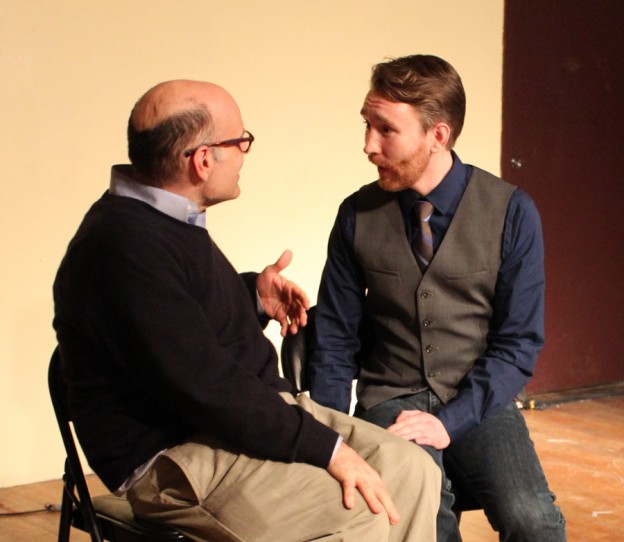
Here is some of what you missed from last week’s Hump Night. Make sure to be there tomorrow night to see Saurin Choksi and Honeybuns!
Most of these photos were taken by Oopey Mason.
Theatre, books, improv, poker, food and dementia
Here is some of what you missed from last week’s Hump Night. Make sure to be there tomorrow night to see Saurin Choksi and Honeybuns!
We tried this template at the end of a rehearsal this week a couple of times. It was a pretty fun one, although I think there is such an inherent game to it, it’s almost short form. It’s a variation on the non sequitur scenes I described a few weeks ago, but this one is for three people:
From here, the scene could go in lots of different ways. Perhaps the conversations could merge, or the third wheel could keep trying to merge the conversations and failing. Since we only did it a couple of times, I’m not sure what all the variations could look like.
I’m realizing that a major theme in my improv thinking these days is how important surprises are. The dialog of improv scenes is often way to linear and gets stuck on whatever topic the players start with. Non sequitur is one tool to fight this tendency.
Please let me know in the comments if you try this and what your thoughts are.
Also, please take a look at my other posts on scene templates.
Please RSVP on Facebook!
Last night I was working with one of the groups that perform at Hump Night. We crafted a template together that was producing some wonderful scenes. The template is a little more complicated than scene templates I’ve written about before. It took us a few steps to get there during the rehearsal. So rather than jumping to the end, I’ll walk through the steps we took.
I’ve been working a lot lately with one person silent scenes. This was first explained to me by Jill Bernard from Huge Theater in Minneapolis (IRC Podcast 2010-02-15 Jill Bernard). The exercise is very simple. You do a two person scene where one person doesn’t speak. All they do is listen, and all they have to do is listen.
Hey there,
Five months ago, I started a variety show called Hump Night. If you follow me, you’ve probably heard about it. You may have come to see it once or twice. Maybe you have even performed at Hump Night. Well, if you like Hump Night, if you have been getting something out of it, I could use a little help.
The deal I have with Strawdog is pretty good. They don’t charge me upfront for the space. Instead, they have a bar in the back of the room. They have a certain minimum that they’d like the bar to make and if they don’t reach that, then I have to make up the difference. Many times, that hasn’t been a problem. Between the donations and the bar, I haven’t had to pay a lot each week. And in the beginning, the students who were performing were essentially subsidizing the rest of the night. I was using part of the money from their tuition to pay for the space.
However, some nights it has cost a lot to run the show. Sometimes we don’t sell much at the bar and we don’t take enough in donations and I end up spending more to keep Hump Night going, then I earn for coaching the teams that perform there.
So there are a few things I could do.
So what can you do? Maybe you perform at Hump Night, maybe you have come to see some shows. If you get something out of the show and you want to see it continue past July, there are some things you can do.
The thing is with the number of people participating in Hump Night in some fashion it shouldn’t be hard to make enough to keep it going. And I don’t mind pitching in a few bucks myself.
I think though, if I’m asking for money so directly, I’m going to take a leap here myself. It’s a small one, but I’m going to change how the donations work. I think people aren’t really sure what happens to the donations and so they are a little reluctant to give. So every show, I’m going to give half the donations to the performers in the Variety Hour. It probably won’t be a huge amount, but I have a hunch that if I give away half, the audience will be more apt to throw some money in the bucket. And this new policy starts tonight.
See you at Hump Night!
-Kevin
The improv hour features teams of players coached by Kevin Mullaney
Kevin invites a great improvisor to play, who invites a third, who invites a fourth who invites one more. This week’s guests:
PAY WHAT YOU WANT – Donations appreciated.
This scene template is a particularly fun one. It feels a little like a trick, but it can have surprisingly delicious results. It starts very much like the Activity to Point of View scene template that I described on Wednesday. One person enters and starts an activity and another person joins that activity. But when the players speak, it’s completely different.
Some things to keep in mind:
Let me know in the comments if this is clear. I am tempted to over explain and add examples, even when they are not necessary. So let me know if it’s needed.
This is the third post in a series on scene templates for improv scenes. Check out Part 1 – You Statements and Part 2 – Activity to Point of View.
One person starts an activity, a second player joins the activity, the first person stakes out a point of view and the second person yes-and that point of view.
On Monday I posted a template for beginning a scene that I called You Statements. Of course, you statements can be used effectively at nearly any point in a scene. Come to a dead end? Observe your partner and make a you statement. Notice your scene partner having a specific reaction to something? Make a you statement. Feel disconnected from your scene partner? You statement.
But this is not the only good way to start a scene. Here is another one I like.
From here, the scene can go in lots of directions. Sometimes the point of view will continue to build and eventually become so strange that one character peels off and decides that they don’t feel the same as the first. Sometimes they will share the same point of view throughout the scene. The way to keep this scene fresh is to keep bringing up new things to talk about and see how the point of view applies to these other topics of conversation.
This scene template can also work with you statements. Instead of stating a point of view in step three, say a you statement about your scene partner and yes-and from there. Observing behavior, you statements, stating points of view, emotional responses and yes-anding are all building blocks that you can mix and match to make a great scene.
* I really do mean do the same thing. I’m sure you realize that you can make a perfectly good scene from one person reading the paper and another person sweeping the floor. Or if one person is working on a car, another person can be writing a sonnet nearby. But your first instinct should be to join the activity always. Subtle complimentary activities can work for the exercise however. For instance, if one person is washing the dishes and another person is drying them.
Scene templates can be very useful for improv scenes. It’s good to have a simple game plan or strategy to help start a scene. And it’s good to practice those strategies over and over so that they become second nature. There is no single right template. Just like there are lots of good ways to begin a chess game or lots of different successful plays in football or basketball, there are lots of good ways to begin a scene.
Here is one that I like.
Obviously, this covers just the first 20 or 30 seconds of the scene and there are lots of ways to go from here. But that simple act of observing your scene partner and caring enough to call out their behavior instantly connects the two players. The audience is drawn into moments like this. It’s always interesting. Nothing clever is needed, because humans are fascinated with human behavior.
As you get better at this, you can probably shorten the amount of time you wait before you say something. Eventually you may want to force yourself to make the observation quickly instead of waiting.
Saturday, June 1, 2013At Upstairs Gallery
5219 N Clark
Third Floor
Chicago
Observe your scene partner, call out their behavior, respond impulsively and let the circumstances tumble out to make a game.
Some of the most fun games to play in a scene come from the emotional interplay of the characters. One player’s behavior inspires an impulsive response in their partner. Patterns of behavior emerge and help form behavior-based games. Justifications bubble up from your unconscious to make sense of what’s happening which leads to more ideas of how to play the game.
For more information about what this class will be about, take a look at the following essays:
This one day intensive class is open to improvisors of all levels.